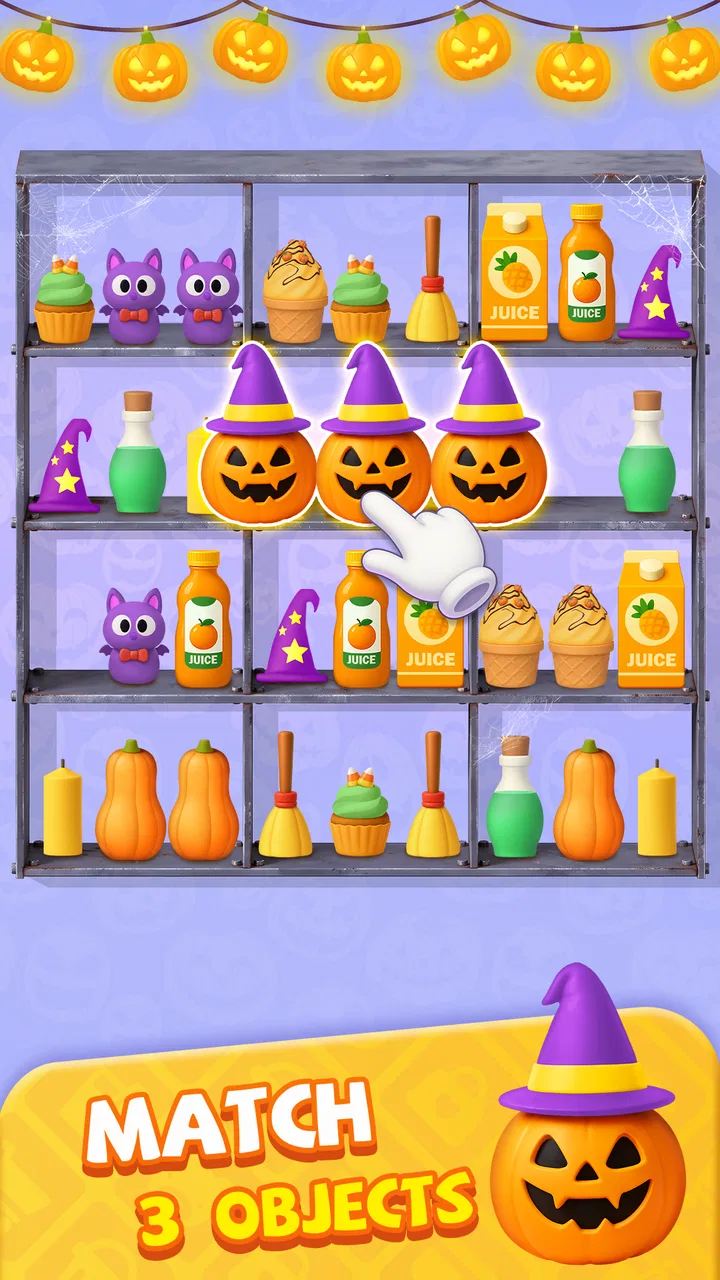
Goods Rush! 3D Sort Puzzle
- 4.7
- Rating
- 1.00M
- Installs
- Free
- Price

 Analysis by App-foxy
I approached Goods Rush! 3D Sort Puzzle expecting a light sorting game, and that is exactly where it feels most comfortable. The basic idea is easy to understand: shelves hold mixed goods, and I work through the clutter by placing matching items together. It is a puzzle game for Android rather than a story-driven adventure, so the pleasure comes from noticing patterns, making tidy decisions, and clearing a shelf without turning a manageable mess into a problem.
That simplicity makes it a reassuring choice for a first-time player. I do not need to learn a complicated control scheme or remember a long backstory before playing. The appeal is immediate, especially when I want something I can pick up for a short break. At the same time, the three-dimensional presentation gives the sorting task more visual weight than a flat matching board. Objects occupy space, their positions matter, and I have to look carefully instead of relying only on quick color recognition.
From the first shelf to a satisfying clear
I begin with the simple pleasure at the heart of Goods Rush!: a crowded shelf gives me a clear, small problem to solve, and each thoughtful match makes the scene feel more manageable. This section looks at why that first interaction is easy to grasp, while also showing how a little attention to visibility can make the difference between a tidy clear and a messy sequence of guesses.
You May Also Like

 Blood Strike: 2.5 Anniversary
Blood Strike’s Loadouts Turn Every Drop Into a Tactical Gamble
A close look at Blood Strike’s custom loadouts: how fast access to signature weapons reshapes its battle royale rhythm, rewards preparation, and narrows the gap between fights.

 Pandora - Music & Podcasts
Pandora’s Music Is Easy to Start, but Harder to Recover
Pandora’s strength is its low-effort path from a seed to a station. Its weak spot is how much confidence it asks you to place in connection, setup, and quiet recovery.

 8 Ball Pool
 Is Built on Rivalries, Rematches, and Routine
A close look at the rivalries, rematches, shared routines, and unanswered safety questions that turn a quick pool match into a persistent mobile community.

 Samsung Music
’s Quiet Strength Is Playing What You Already Own
Its reach comes less from spectacle than from dependable access to a personal library. That simplicity is both the app’s strongest retention engine and its ceiling.

 AccuWeather: Weather Radar
AccuWeather Review: A Quick, Clear Forecast for Everyday Decisions
For everyday plans, the best forecast is the one you can understand quickly. AccuWeather makes rain timing, radar, and local conditions easy to act on, with a few trade-offs.

 Hill Climb Racing
Why Hill Climb Racing Still Turns Crashes Into One More Run
A tiny car, a bumpy hill and one more upgrade: Hill Climb Racing keeps resurfacing because its simple chaos makes every near-miss feel personal.
More From Our News Desk



What to expect when you begin
The game comes from Playdayy and is listed as a free puzzle title for Everyone. It has attracted over one million installs and holds a 4.7 average from around 152 thousand ratings, which suggests that the central sorting loop has found a broad audience. I can see why: the rules are approachable, but the act of organizing a crowded shelf still gives each round a small sense of purpose.
Before installing, I would keep one practical detail in mind. The game is free to start, while optional in-app purchases range from $1.99 to $99.99 per item. That does not change the opening experience, but it is worth remembering if the device is shared with a child or if I prefer to avoid accidental spending. The Everyone age rating makes the game accessible to a wide audience, yet purchase awareness is still sensible for any free-to-play title.
The current version is 1.0.27 and requires Android 7.0 or later. For someone using an older phone or tablet, checking the operating system before trying to install will save time. On a compatible device, the first impression is refreshingly direct: the game’s identity is built around shelves, goods, and sorting rather than menus that make me work to reach the puzzle.
Setting up without overthinking the start
My advice to a new player is to begin slowly. The first shelf is not the place to prove how quickly I can tap. I use the opening moments to identify which objects belong together and to notice how the game communicates a selected item. That small pause matters because three-dimensional layouts can make two similar goods look close even when they occupy different positions.
I also recommend holding the device in the position that gives the shelf the clearest view, rather than choosing a posture based only on habit. In a sorting puzzle, visibility is part of the solution. If an object is partly hidden or I am viewing the arrangement at an awkward angle, I am more likely to make a move that looks logical but leaves the remaining goods harder to manage.
There is no benefit in treating the opening like a race. I first scan the whole arrangement, then choose a pair or group that is easy to recognize. This creates a mental map of the shelf before I disturb it. That is a useful habit in Goods Rush! because every successful placement changes what I can see next. The best opening move is often not the item I noticed first, but the one that exposes another useful match.
The first meaningful success
My first real success comes from completing a clean match rather than tapping randomly until something works. I look for goods that are clearly identical or belong to the same visible set, select them in a deliberate order, and watch how the shelf changes. Once a group is organized, the next layer becomes easier to read, and the puzzle starts to feel less like a pile of objects and more like a sequence of small decisions.
This is where the game’s strongest beginner lesson appears: sorting is also about preserving future visibility. A move can be correct and still be inconvenient if it blocks the item I need next. I therefore try to clear exposed goods before reaching into a crowded section. That approach is more reliable than focusing only on the nearest matching pair.
For an everyday example, I can imagine playing during a short break while waiting for a bus. I would finish one small sorting objective, put the phone away, and return later without needing to reconstruct a complicated strategy. The game suits that rhythm because its central action is understandable within seconds. It also works at home when I want a calmer activity than a fast arcade game, especially when visual organization itself feels satisfying.
When a shelf begins to open up, I resist the temptation to speed up immediately. I keep checking the remaining goods after each placement. That extra glance helps me spot newly exposed matches and prevents the common mistake of committing to a move simply because it is available. The reward is not only completion; it is the feeling that the final clear happened because I read the shelf well.
Where new players can become confused
The most likely confusion is assuming that every visually similar item should be moved together without first considering the shelf’s layout. In a three-dimensional puzzle, an object may look available while another item is effectively more important because it is covering a useful route through the arrangement. I treat the board as a small workspace, not as a collection of isolated pictures.
Another mistake is tapping too quickly when several goods look alike. I slow down and confirm the item I am selecting before making a chain of moves. This is especially helpful when the shelf contains repeated shapes or colors. A deliberate rhythm—look, choose, check—keeps the puzzle relaxing instead of turning a simple error into a frustrating restart or recovery.
I also avoid clearing one visible area while ignoring the rest of the shelf. Local progress can be misleading. A tidy corner does not always mean the overall position is improving. I scan for matches that will reveal the most space, then use those openings to decide what deserves attention next. This is a more advanced habit, but it can be learned from the very first round.
Players who expect a traditional match-three game may need a short adjustment. This is not simply about swapping neighboring tiles to create an immediate combination. The shelf arrangement and the order of actions matter more, so the challenge comes from organizing objects in a useful sequence. Players who enjoy visual clutter being transformed into order will probably appreciate that difference; players seeking rapid effects and constant motion may find the pace too measured.
A practical method for harder-looking shelves
When the arrangement becomes less obvious, I divide the shelf mentally into three groups: goods that are already easy to reach, goods that are partly obscured, and goods that I should leave alone until more space is available. I start with the first group, but I choose moves that also improve access to the second. This prevents me from spending all my attention on simple matches while the important blockage remains untouched.
A second useful technique is to avoid using the same visual clue every time. If I sort only by color, similar goods can mislead me. I compare shape, packaging, and position together. The game’s three-dimensional design rewards this broader scan because the object’s location affects how confidently I can plan the next action.
I find it helpful to pause after a successful group rather than immediately tapping the next obvious item. The shelf may have changed enough to create a better option. This pause is not wasted time; it is a way to refresh the puzzle in my mind. It also makes the experience more accessible for younger players or anyone who prefers careful play over speed.
One trade-off is that the same clear-and-organize loop can feel repetitive if I want a wide variety of puzzle rules. Goods Rush! focuses its identity rather than constantly changing genres. I would choose it over a more complicated puzzle collection when I want one readable mechanic, but I would choose a broader puzzle app when I need word challenges, number problems, or radically different objectives in the same session.
How it compares with familiar sorting alternatives
Compared with a basic color-matching game, this title asks me to pay more attention to object identity and shelf position. That makes it feel more tactile and spatial, even though the underlying goal remains easy to understand. Compared with a hidden-object game, the emphasis is not on searching for one unusual item; it is on building an orderly result from several related goods.
It also differs from fast match-three games in mood. Those games often reward quick combinations and dramatic momentum. Here, I get more value from planning a sequence and keeping the arrangement readable. If I am commuting and want a calm puzzle that can be understood without sound, this is the kind of alternative I would consider. If I want competitive speed, elaborate power-ups, or a strong narrative, another category would likely suit me better.
The free entry point is another reason it is easy to try, but the purchase range means I would make my spending decision early. I can enjoy the core concept without treating every difficult moment as a reason to buy something. My preferred approach is to use patience and better shelf reading first. That keeps the game aligned with its strongest quality: the satisfaction of solving a visual organization problem.
Who will enjoy it, and who should skip it
I would recommend this game to players who like tidy-up mechanics, object matching, and short puzzle sessions. It is particularly suitable for someone new to mobile games because the main idea is visible rather than buried behind complicated instructions. It can also work for families looking for an accessible puzzle, provided an adult manages purchase settings on a shared device.
I would be more cautious recommending it to anyone who dislikes repetition or needs every round to introduce a new rule. The focused design is a strength when I want consistency, but it can be a limitation when I am looking for constant novelty. Players who prefer action, competition, or deep long-form strategy should also look elsewhere; the pleasure here comes from arranging goods thoughtfully, not from mastering a large combat or resource system.
Another consideration is attention style. I enjoy the game most when I can give the shelf a few uninterrupted moments. Although the rules are simple enough for a quick session, careless tapping makes the experience less satisfying. Someone who wants a game that can be played almost automatically may find that the visual planning still asks for more concentration than expected.
What I would do after the first clear
After completing the first meaningful sorting task, I would not immediately chase speed. I would replay the same mental process on the next shelf: scan first, clear accessible matches, protect visibility, and reassess after every change. That routine turns the game from a guessing exercise into a repeatable skill. The improvement I notice is not faster fingers but better decisions about which goods deserve attention.
I would also use the next few sessions to decide whether the focused loop has enough staying power for me. The answer depends on what I want from a puzzle game. If I enjoy gradually becoming more efficient at reading clutter, the structure has a clear appeal. If I need a constantly expanding set of mechanics, I should treat this as a pleasant side game rather than my only puzzle title.
My final view is positive, with a clear qualification. Goods Rush! 3D Sort Puzzle is an approachable Android sorting game that makes a small task—organizing shelves—feel rewarding through spatial attention and orderly progress. Playdayy keeps the entry barrier low, and the free starting point makes trying it straightforward. I would recommend it to a friend who wants a calm, visually focused puzzle, while reminding them to play deliberately and keep the optional purchase range in mind.
For me, the best reason to install it is not the promise of endless novelty; it is the reliable satisfaction of turning a crowded shelf into a clean one. Start with one careful match, watch what becomes visible, and let the next move follow from the new arrangement. That approach captures the game at its best and gives a first-time player a smooth path from uncertainty to a genuinely satisfying clear.
FAQs for Goods Rush! 3D Sort Puzzle
01What is Goods Rush! 3D Sort Puzzle?
Goods Rush! 3D Sort Puzzle is a casual organizing game focused on sorting colorful products into matching groups. You usually arrange items on shelves, combine identical goods, and complete customer or level objectives before running out of available space. Its simple controls make it easy to start, while increasingly crowded layouts and limited moves add a moderate puzzle challenge.
02How do you play Goods Rush! 3D Sort Puzzle?
Gameplay is based mainly on tapping, selecting, and rearranging items so that identical products are placed together or combined according to the level’s rules. Before making a move, it is useful to check the entire shelf layout, because placing an item in the wrong position can block other goods. Later stages require more planning, patience, and careful use of available spaces.
03Is Goods Rush! 3D Sort Puzzle free to download and play?
The game can generally be downloaded and played without an upfront purchase, but free gameplay may include advertising, optional in-app purchases, or both. Ads can sometimes provide rewards such as extra moves, hints, or boosters. Before downloading, check the store listing for the current pricing, supported devices, and purchase information, since these details may change with updates.
04Does Goods Rush! 3D Sort Puzzle require an internet connection?
Basic puzzle levels may be available without a continuous internet connection, which makes the game suitable for short offline sessions while traveling or waiting. However, some features can depend on connectivity, including advertisements, cloud progress, events, leaderboards, and purchases. If offline play is important to you, test the game after disabling mobile data and Wi-Fi, because availability can vary by version.
05Is Goods Rush! 3D Sort Puzzle suitable for children and casual players?
Goods Rush! 3D Sort Puzzle is designed for casual players and is generally easy to understand because it uses familiar sorting mechanics and straightforward touch controls. Nevertheless, parents should review the game’s advertising and in-app purchase settings before allowing children to play. Difficulty can increase in later levels, so younger players may occasionally need help with planning or managing limited moves.
Pros
- Simple drag-and-drop controls are easy to learn.
- Short levels make it suitable for quick play sessions.
- Colorful 3D visuals make items easy to distinguish.
- Sorting tasks offer a relaxing break from action-heavy games.
- Progressive challenges keep the basic gameplay from feeling repetitive.
Cons
- Some levels can feel repetitive after extended play.
- Difficulty may depend more on patience than strategic depth.
- Small 3D objects can be harder to identify on compact screens.
- Frequent interruptions may affect the otherwise relaxing pace.
- Players seeking complex puzzles may find the mechanics too simple.

Goods Rush! 3D Sort Puzzle
Gallery